
Towards Establishing an Internal Paradigm for Islamic Scholarship in Europe
Article Sidebar
Main Article Content
Abstract
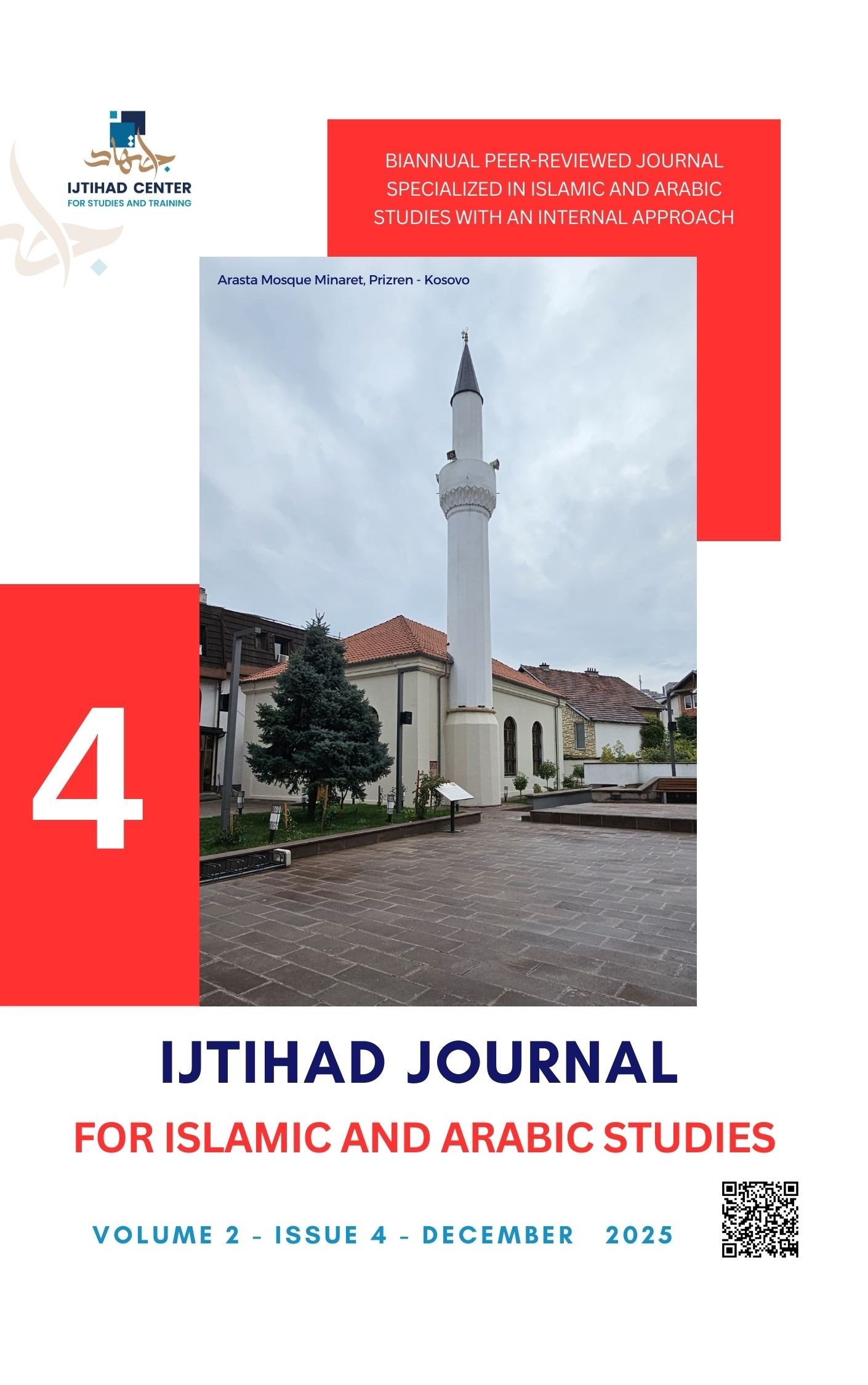
This editorial introduces the fourth issue of the Ijtihad Journal for Islamic and Arabic Studies and outlines its scholarly vision, methodological orientation, and academic contributions. It highlights the challenges of establishing a peer-reviewed journal in the European context, particularly one that adopts an internal, academically rigorous, and objective approach to Islam. The journal positions itself as a corrective to the dominance of external Orientalist and Islamological paradigms by seeking to reconcile internal Islamic epistemologies with critical engagement with Western academic scholarship.
The editorial further emphasizes the intellectual and humanistic mission of the Ijtihad Center, which aims to make Islamic juridical, theological, philosophical, and literary heritage accessible to both specialists and broader audiences, while challenging reductive and exoticizing representations of Islam. It also underscores the journal’s success in attracting a new generation of scholars who combine a strong grounding in Islamic knowledge with Western academic training, thereby contributing to the emergence of an innovative research current in Europe and the West.
Finally, the editorial presents the contents of the fourth issue, including four peer-reviewed articles, two book reviews, and a translated study, marking a significant milestone with the launch of a separate English-language issue alongside a forthcoming Arabic edition. Together, these contributions reaffirm the journal’s commitment to scholarly excellence and intellectual dialogue.
Article Details

This work is licensed under a Creative Commons Attribution-ShareAlike 4.0 International License.

© Authors retain full copyright of their published works. Articles published in the Journal are distributed under the Creative Commons Attribution–NonCommercial 4.0 International License (CC BY-NC 4.0). This license permits others to download, read, share, reproduce, and adapt the work for non-commercial purposes, provided that appropriate credit is given to the original author(s), a link to the license is provided, and any modifications are clearly indicated. Commercial use of the work is not permitted without prior authorization from the copyright holder(s).